





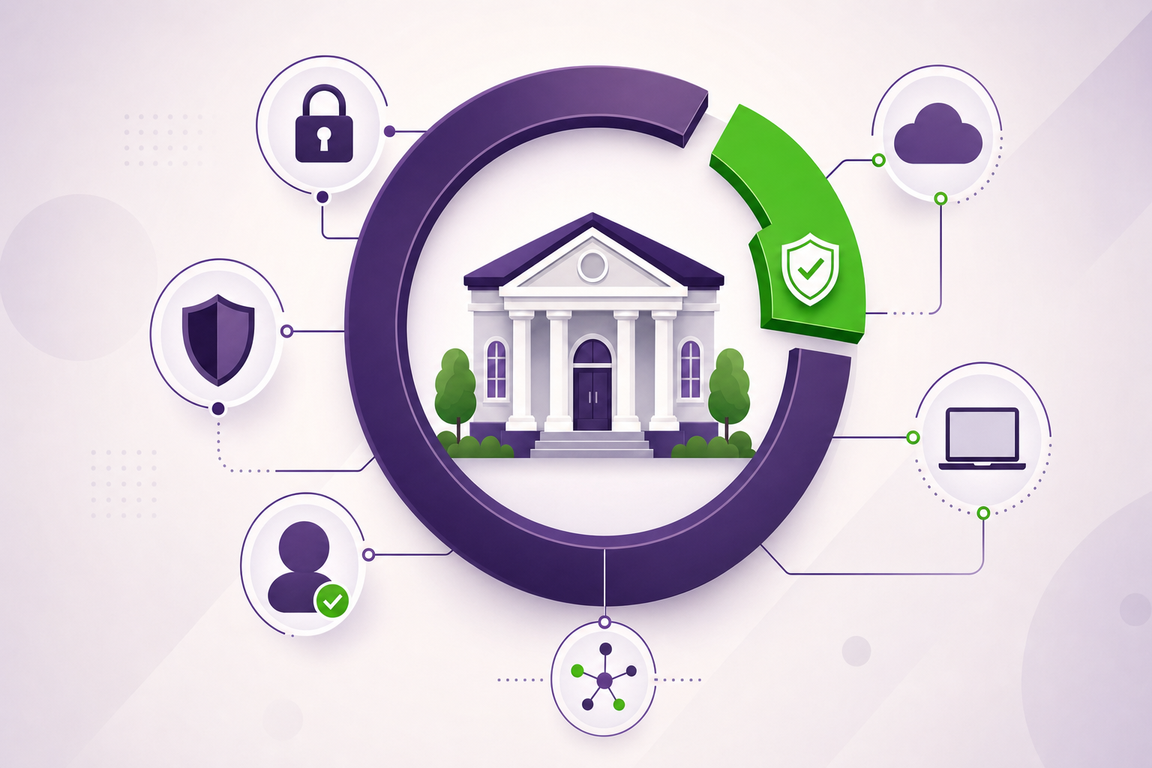






Community banking depends on digital systems that run around the clock. That creates a basic security problem: many community banks cannot maintain a current view of every asset, identity, application, and third-party connection in their environment.
Periodic audits and isolated security tools leave gaps. Attackers can take advantage of cloud resources that were never recorded, exposed APIs, vendor access, stolen credentials, and systems that missed a patch. Community banks need continuous visibility, consistent security practices, and monitoring that continues after business hours, but often lack the resources to build and maintain a large internal security team.
Understand the cybersecurity gap in community banking.
A community bank’s attack surface includes its networks, applications, APIs, endpoints, cloud services, devices, user identities, and third-party connections. That surface expands as banks adopt digital banking tools, rely on core banking providers, work with fintech companies, move services to the cloud, or open new branches.
The problem is that asset growth often moves faster than small IT and security teams can track it. Firewalls and annual vulnerability scans still have a place, but they cannot provide a current view of a changing environment. Manual patching, older systems, separate compliance programs, and excessive administrative access create room for attackers.
Older approach | Current strategy |
Perimeter defense and periodic audits | Continuous monitoring of endpoints, identities, and applications |
Compliance as the end goal | Compliance as a baseline for security decisions |
Manual issue tracking | Automated, risk-based remediation |
Without current asset data, security teams have trouble deciding what to fix first. For community banks, the issue is often not a lack of effort so much as a lack of time, staff, and unified visibility. A managed vulnerability program can bring asset discovery, risk scoring, and remediation guidance into one process. Magna5 supports this through vulnerability management services, external attack surface monitoring, Managed SIEM/MDR, EDR, and vCISO advisory services that help organizations prioritize risk and coordinate remediation.
Build a current asset and attack surface inventory.
A community bank cannot protect systems it does not know about. A live asset inventory should cover on-premises infrastructure, cloud resources, software, identities, branch devices, and external connections.
Asset and Attack Surface Management tools can discover and classify systems, then connect that information to vulnerability and identity data. This helps IT teams find shadow IT, forgotten servers, exposed APIs, unmanaged endpoints, and vendor connections before they become entry points.
A useful inventory should include:
Asset type | Examples |
Endpoints | Workstations, ATMs, teller systems, branch laptops |
Servers and virtual machines | Core banking servers, virtualization hosts, file servers |
Network and branch devices | Firewalls, switches, wireless access points, routers |
APIs and SaaS applications | Digital banking platforms, third-party software, fintech integrations |
Directory services | Active Directory, identity providers, privileged accounts |
Use a cybersecurity framework as a starting point.
A compliance framework gives a community bank a structure for managing risk. It does not tell the IT team what deserves attention today.
Common frameworks include:
Framework | Main focus | Typical use |
NIST CSF | Identify, protect, detect, respond, recover | Cybersecurity risk management benchmark |
FFIEC CAT | Financial-sector risk supervision | U.S. banks and credit unions |
CIS Controls | Prioritized security safeguards | Practical control implementation |
ISO 27001 | Information security controls and certification | Larger or more formal programs |
Community banks get more value from these frameworks when they connect them to current threats and daily operations. That can mean hardening remote access, testing digital banking systems, reviewing privileged access, improving vendor oversight, and running compromise assessments instead of treating a completed checklist as proof of safety. The useful question is simple: what does the bank need to fix this month, and who owns it?
Combine security telemetry with 24/7 detection.
A single security tool cannot see every attack. Endpoint, identity, network, and application data need to be collected and reviewed together.
A layered monitoring program may include:
- EDR to track suspicious activity on devices
- ITDR to identify credential abuse and identity attacks
- SIEM to connect alerts from multiple systems
For many community banks, the challenge is not deciding whether 24/7 monitoring is useful but rather staffing it. These signals can feed a security operations center or a Managed Detection and Response service that provides after-hours coverage without requiring the bank to build a full internal SOC.
Magna5’s MDR and Managed SIEM services provide 24x7x365 SOC monitoring, alert validation, investigation support, and coordinated response based on customer escalation procedures and playbooks. When paired with EDR, automated endpoint containment and remediation capabilities can help reduce the impact of active threats. The workflow is straightforward: collect the signal, determine whether it represents a threat, then take action before the issue spreads.
Apply Zero Trust to identity and access.
Zero Trust requires the bank to verify each access request instead of assuming that a user or device is safe because it is inside the network.
A practical Zero Trust program should:
- Require MFA for every login.
- Give users only the access they need for their work.
- Review access activity for unusual behavior.
- Check device and identity risk during access decisions.
Community banks should separate internal systems, customer-facing applications, branch networks, and third-party connections. If one account or application is compromised, segmentation can limit the attacker’s reach.
This matters because phishing remains a common way to steal credentials. Strong authentication, device checks, privileged access management, and regular access reviews make stolen passwords less useful.
Move security checks into development and patching.
“Shifting left” means testing software earlier, before a release reaches production. For community banks, it can also mean making sure vendor-managed applications, digital banking tools, and internal changes are reviewed before they create risk.
A secure software and change management process can include:
- Application and API scans during testing
- Review and approval for production changes
- Continuous vulnerability prioritization
- Fast patching for exposed systems and high-risk assets
The priority should be based on exposure and business impact. A low-severity issue on an isolated test server does not deserve the same attention as a known vulnerability on an internet-facing digital banking service.
Protect digital banking channels and APIs.
Digital banking systems are attractive targets because they move money and handle sensitive customer data. Instant payments, mobile banking, online account opening, and fintech integrations also create more connections that community banks need to monitor.
Banks may use transaction monitoring or fraud analytics tools to identify unusual payment patterns and possible account takeover activity. API controls should include strong authentication, request validation, rate limits, encryption, and ongoing monitoring.
Security teams should also test how digital banking APIs and integrations respond to abuse. Simulated attacks can expose weak authorization, excessive data access, or missing rate limits before a real attacker finds them.
The goal is to make suspicious activity visible while transactions are still in progress, not after a customer reports fraud or a loss has occurred.
Strengthen vendor oversight and employee training.
A community bank’s security program extends to the companies that connect to its systems. Vendor reviews should cover access rights, security requirements, incident reporting, testing, and the removal of access when a relationship ends.
Employee training needs to be specific enough to use. Scenario-based exercises can show staff how to handle phishing messages, unexpected MFA prompts, requests for sensitive data, wire transfer pressure, customer impersonation attempts, and unusual administrator activity.
Leadership also needs a clear view of security performance. Useful reporting can include unresolved high-risk assets, time to contain incidents, privileged accounts without recent review, and vendor connections that need attention.
FAQs about community banking cybersecurity.
Q: What is the biggest cybersecurity gap facing community banks?
A: For many community banks, the gap is the absence of continuous visibility across a large and changing technology environment. Without current asset, identity, application, and vendor access data, teams can miss exposed systems and struggle to prioritize remediation.
Q: How can community banks reduce human and identity risk?
A: Community banks can require MFA, limit privileged access, review permissions regularly, and monitor for unusual sign-in behavior. User awareness training should use real examples of phishing, social engineering, wire fraud attempts, unexpected MFA prompts, and account takeover activity.
Q: How do community banks secure cloud and digital banking channels?
A: They need to map cloud assets, APIs, endpoints, identities, and vendor connections, then apply access controls and continuous monitoring to each one. Zero Trust practices can help limit access and contain a breach.
Q: What does continuous monitoring add?
A: Continuous monitoring gives security teams current information about suspicious activity and changes in the environment. It can reduce the delay between an attacker gaining access and the bank discovering the problem.
Q: How can community banks work with limited internal resources?
A: A managed security provider can supply 24/7 monitoring, detection, investigation, and response support. A co-managed approach lets internal teams retain control while using outside analysts for coverage, specialized work, and after-hours monitoring.
Community banks can close the visibility gap by maintaining a current asset inventory, monitoring identities and endpoints, protecting digital banking systems, and assigning clear ownership for remediation. The first practical test is whether the team can produce a reliable list of every internet-facing asset, privileged account, and critical vendor connection today. If it cannot, that is where the work starts.