





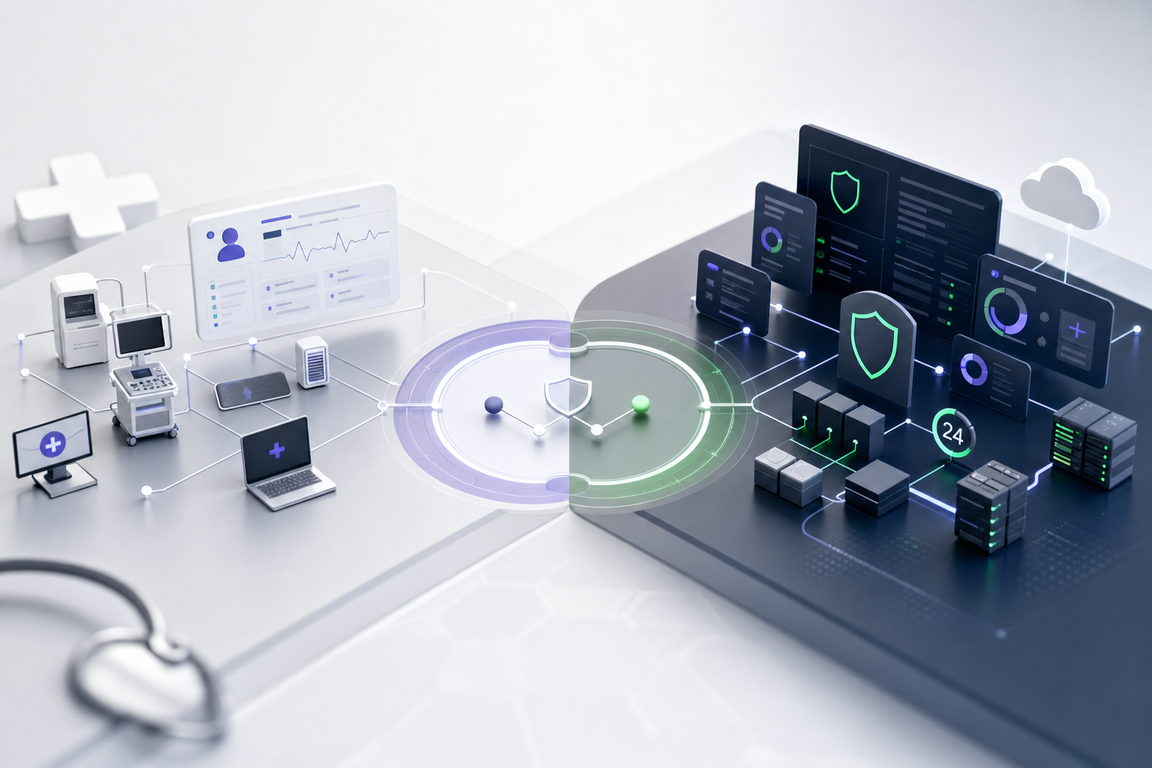






Healthcare practices face unrelenting pressure to maintain secure, compliant, and always-available systems while managing costs and staffing constraints. Co-managed IT services offer a proven way to bridge these challenges: blending your in-house IT expertise with a managed service provider’s advanced resources, tools, and 24/7 monitoring. This hybrid model gives healthcare organizations greater flexibility, strengthens patient data protection, and improves system resilience, all without losing operational control. Here are seven clear benefits of co-managed IT for healthcare and how to evaluate the right partner for long-term success.
Improved cybersecurity and continuous monitoring.
Protecting patient information is non-negotiable. Co-managed IT strengthens your healthcare cybersecurity posture with continuous monitoring, proactive threat detection, and defined escalation workflows. For many medical practices, capabilities such as EDR, MDR, SIEM, vulnerability management, MFA, and managed firewall monitoring can be difficult to build and maintain entirely in-house.
An MSP like Magna5 can help support a layered security approach that may include endpoint detection and response, managed SIEM or MDR, managed firewall monitoring, patching support, vulnerability scanning, multi-factor authentication, and user awareness training. These services improve visibility across endpoints, networks, users, cloud platforms, and critical systems.
Continuous monitoring helps identify suspicious activity sooner, reduce alert fatigue, and coordinate response before threats disrupt clinical operations or compromise sensitive patient data.
Stronger compliance posture.
Healthcare compliance is not just about checking HIPAA boxes. It is essential to maintain documented, auditable, and consistently enforced safeguards. Co-managed IT can simplify this process by improving visibility into security controls, supporting evidence collection, and helping teams prepare for audits while internal staff retains oversight and accountability.
An MSP like Magna5 can help healthcare organizations support compliance efforts through compliance-focused reporting, security assessments, backup documentation, audit-readiness support, and compliance manager services where applicable. These capabilities can help practices track controls, collect evidence, and identify gaps that may require remediation.
It is important to frame compliance accurately: no provider can guarantee compliance on its own. Magna5 helps support compliance programs by providing tools, reporting, monitoring, and advisory services that strengthen audit readiness and improve visibility into compliance status.
Higher operational resilience and faster escalation.
Every minute of downtime can affect patient care. Co-managed IT helps preserve operational resilience by sharing responsibility for monitoring, patching, device management, backups, security alert triage, and incident escalation between your staff and your managed IT partner. When issues arise, predefined escalation paths reduce confusion and help ensure accountability.
Rather than relying solely on an internal team, healthcare practices gain access to additional technical resources and 24/7 monitoring support. This can help accelerate troubleshooting, improve consistency, and reduce the operational burden on internal IT teams.
Backup and disaster recovery services can also support resilience through encrypted backups, offsite replication, recovery planning, 24/7 monitoring, and disaster recovery testing where applicable. Recovery expectations should be defined during scoping and depend on the protected workloads, architecture, selected recovery model, and agreed RPO/RTO targets.
Access to advanced tools at lower cost.
Healthcare IT often requires monitoring consoles, endpoint security, compliance tools, backup platforms, and reporting capabilities that can be costly and complex to maintain internally. Through a co-managed model, practices gain access to enterprise-grade tools and expertise without having to build every capability from scratch.
An MSP like Magna5 can help provide or manage capabilities such as security monitoring, endpoint protection, managed SIEM or MDR, vulnerability management, backup and disaster recovery, Microsoft 365 support, cloud management, compliance reporting, and strategic IT advisory. This approach gives practices access to advanced resources while allowing internal IT staff to stay focused on the environment and users they know best.
Pricing should be scoped based on actual needs rather than assumed as a fixed package. Depending on the services selected, pricing may be based on users, devices, log volume, protected data size, licensing, cloud scope, compliance requirements, and managed service tiers. This helps healthcare practices align IT investment with operational priorities.
Scalability and staffing flexibility.
As your practice expands—adding locations, telehealth capabilities, providers, applications, or new systems—your IT and security requirements evolve. Co-managed IT scales more flexibly than internal hiring alone, allowing you to add monitoring, support, security, or compliance resources as needs change.
For example, a healthcare practice may need additional support during a new location rollout, EHR project, Microsoft 365 change, security initiative, backup redesign, or compliance review. Co-managed IT gives internal teams access to specialized resources without requiring every skill set to be permanently staffed in-house.
Magna5’s co-managed model can adapt as operations grow, consolidate, or become more complex. Service scope can be adjusted based on device counts, user counts, security add-ons, cloud environments, protected data, or compliance requirements.
Frees internal staff for strategic work.
Your internal experts deliver the most value when they can focus on projects that improve patient experience, workflow, and operational efficiency rather than just day-to-day troubleshooting. Co-managed IT partners can help manage routine monitoring, patching, backup oversight, security alert triage, help desk escalation, and defined maintenance tasks.
This gives internal IT teams more time to focus on higher-value initiatives such as EHR optimization, workflow automation, analytics integration, cloud modernization, security planning, and user experience improvements. It can also reduce burnout by giving internal teams additional support when ticket volume or project demands spike.
With Magna5’s collaborative approach, your internal team gains a proactive extension of your internal IT team, not a replacement. The goal is to preserve institutional knowledge while expanding access to tools, monitoring, expertise, and support.
Predictable budgeting and better resource planning.
Traditional IT expenses can fluctuate due to emergency repairs, unplanned hardware needs, security events, software renewals, or staffing gaps. Co-managed IT helps stabilize planning by defining service scope, support responsibilities, escalation processes, and recurring managed service costs.
Rather than adding full-time staff for every specialized need, healthcare practices can use co-managed IT to access defined services such as monitoring, cybersecurity, backup, compliance reporting, cloud support, and advisory services. This can make IT budgeting more predictable while helping align resources to business and clinical priorities.
IT Model | Cost Predictability | Resource Model | ROI Drivers |
Internal Only | Variable | In-house staff and tools | Direct control, but higher tool and staffing burden |
Fully Managed | High | MSP-managed operations | Outsourced support, monitoring, and standardization |
Co-Managed | High | Shared internal and partner resources | Expanded expertise, scalable support, and operational flexibility |
This predictability can simplify financial planning and strengthen ROI by improving resilience, visibility, security posture, and support coverage.
How to evaluate co‑managed IT partners for healthcare practices.
Choosing a co-managed IT partner is a long-term collaboration. Prioritize proven experience in regulated environments, HIPAA-aligned security practices, strong cybersecurity capabilities, clear service levels, and well-defined escalation procedures.
Key evaluation factors include healthcare or regulated-industry experience, ability to support contractual and compliance requirements such as BAAs where applicable, 24/7 monitoring or support options, backup and disaster recovery capabilities, security operations maturity, transparent reporting, and integration with your existing IT stack.
Also confirm onboarding plans and scope definitions before launch. Magna5 works with clients to define onboarding requirements, access needs, ticketing workflows, escalation procedures, reporting expectations, and ongoing service review processes so both teams remain aligned.
Magna5’s co‑managed IT services.
Magna5’s co-managed IT model is designed for organizations that want to strengthen internal IT capacity without fully outsourcing control. For healthcare practices, Magna5 can support security, resilience, and HIPAA-aligned compliance efforts by pairing your internal team’s institutional knowledge with Magna5’s managed IT, cybersecurity, cloud, backup, and compliance expertise.
Clients can benefit from 24/7 managed services, remote monitoring, vulnerability management, backup and disaster recovery, and cybersecurity services delivered through Magna5’s Pentaguard suite. Depending on scope, these services may include managed detection and response, managed SIEM and SOC monitoring, endpoint security, secure backup and recovery, vCISO/vCIO-style advisory, and compliance reporting.
Co-managed IT with Magna5 keeps your internal team engaged and in control while giving them access to scalable security, monitoring, automation, and support resources that many practices could not easily sustain internally. With national reach and local expertise, Magna5 helps align IT, security, and compliance support so healthcare teams can focus more fully on patient care.
FAQs about co-managed IT for healthcare practices.
Q: What is co-managed IT in healthcare and how does it work?
A: It is a hybrid model where your internal IT team and a trusted partner like Magna5 collaborate to support security, resilience, compliance efforts, and day-to-day IT operations while your organization retains oversight.
Q: How does co-managed IT support HIPAA compliance in medical practices?
A: Co-managed IT can support HIPAA compliance efforts through security controls, monitoring, evidence collection, reporting, audit preparation, backup documentation, and risk visibility. The healthcare organization remains responsible for its overall compliance program.
Q: Can co-managed IT help reduce downtime for critical healthcare systems?
A: Yes. Shared monitoring, defined escalation, backup planning, and access to additional technical resources can improve resilience and speed escalation. Actual recovery timelines depend on the systems, architecture, backup design, and agreed RPO/RTO targets.
Q: What pricing models are typical for co-managed IT in healthcare?
A: Pricing varies by scope. Services may be based on users, devices, log volume, protected data size, licensing, cloud environments, compliance requirements, and service tiers.
Q: How do I ensure clear division of responsibilities between internal IT and the co-managed provider?
A: Conduct regular joint reviews to confirm ownership of monitoring, patching, backups, security alerts, reporting, escalation, and strategic planning. Magna5 supports this with defined scope, transparent communication, and shared service processes.
By partnering with a co-managed IT provider like Magna5, healthcare practices can strengthen security, improve resilience, support compliance efforts, and scale IT capacity, all while empowering internal teams to focus on what matters most: patient care.