





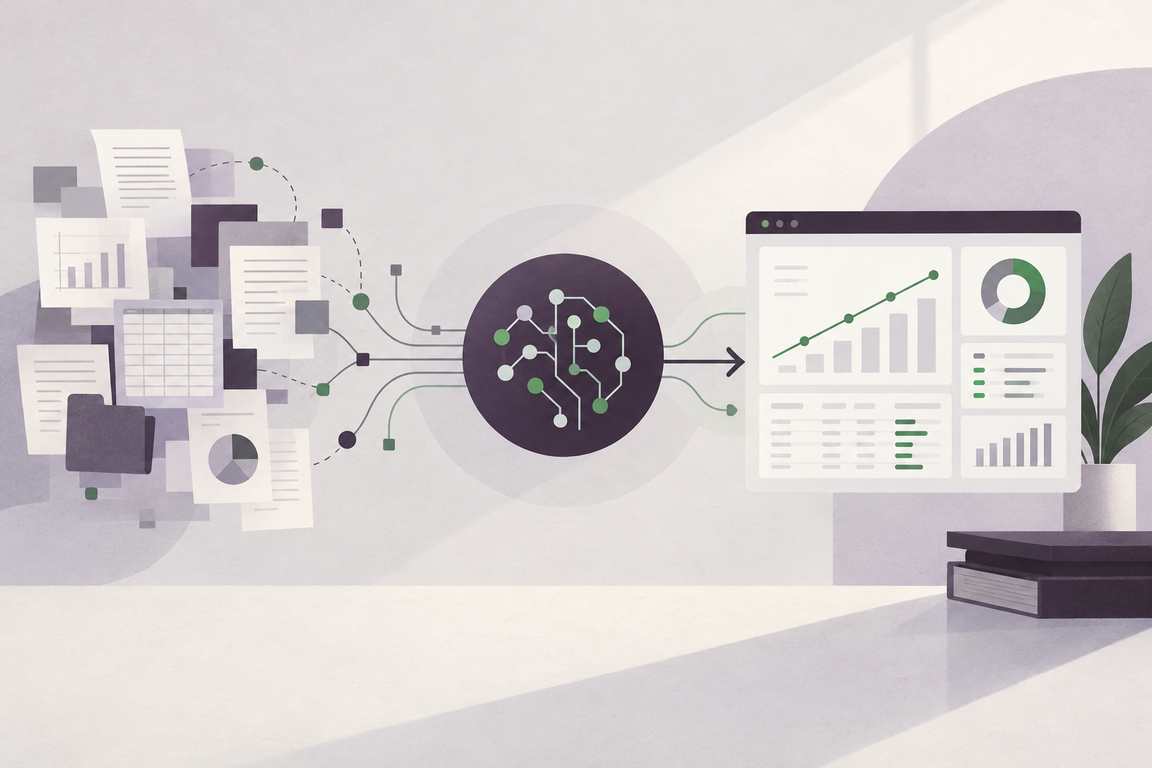






Finance departments are expected to move quickly without sacrificing accuracy. From financial modeling and board reporting to contract review and forecasting, AI can help teams spend less time building from scratch. They can spend more time analyzing results, managing risk, and guiding the business.
At Magna5, we are not simply recommending these applications to clients. Our finance team uses Magna5’s own secure AI capabilities to build models, organize financial data, improve board presentations, evaluate vendor proposals, and explore the automation of recurring reports.
“AI is most valuable when it gives me a better starting point,” said Dan O’Connor, Vice President of Finance at Magna5. “It helps me work through a problem, structure the analysis, and make sure I haven’t overlooked something important.”
These firsthand applications have helped us understand where AI creates meaningful value, where human oversight remains essential, and how other organizations can implement the technology responsibly.
Use AI to build financial models faster.
Complex Excel models often require significant time to structure correctly. AI can:
- Build and edit complex financial models based on customized prompts
- Recommend formulas
- Troubleshoot calculations
- Suggest more effective ways to organize existing models
When Dan is building a model or reporting deliverable, he can describe the desired result to AI and use its recommendations as a starting point.
“My team’s work routinely involves preparation of Excel models and Powerpoint presentations, and the use of our AI tools has allowed us to be significantly more effective with less time commitment,” O’Connor said. “AI enables us to generate strong models and presentations in a matter of minutes where it used to take hours, allowing us to focus more time on solving problems.”
AI accelerates the technical work, but financial judgment stays with the finance team. That distinction is important: AI can recommend how to build the model, while people determine whether its assumptions and outputs make sense for the business.
Use AI to turn raw data into useful reports.
A dataset is only valuable when decision-makers can understand it. Magna5’s finance team uses AI to organize data for analysis, design spreadsheet structures, and determine how financial information should be presented to executives and board members.
“Instead of beginning with a blank spreadsheet, I can give AI a dataset via upload or integration and explain what I need to analyze or present,” O’Connor said. “It helps organize the information and design a useful starting structure. It also learns repeatable skills so prompts and models can be leveraged again in the future, saving even more time following the initial configuration.”
This reduces the blank-page work involved in building reports, so finance professionals can focus on interpreting the numbers. A well-organized structure also makes each report easier to update and repeat from one reporting period to the next.
Use AI to improve board presentations.
AI can also be an editorial partner for monthly and quarterly presentations. It can recommend ways to:
- Simplify slides
- Improve visual consistency
- Identify missing context
- Make complex financial information easier to understand
In addition to converting underlying data into presentation-ready slides, AI helps the team evaluate whether the presentation tells a complete and understandable story.
“I can ask AI how to make a presentation cleaner and whether anything is missing conceptually,” O’Connor said. “It gives me another perspective before the material goes to leadership or the board.”
The result is a cleaner presentation and a stronger financial narrative. Because AI can review a draft quickly, the team can refine its materials through several passes without significantly extending the reporting cycle.
Add a second layer of review with AI.
Finance teams make decisions that can affect every part of the organization. AI gives teams an additional confidence check by helping them ask:
- Have we overlooked an important variable?
- Is anything missing from the analysis?
- Are there inconsistencies in the supporting data?
- What questions might leadership ask?
“AI gives me an extra confidence check,” O’Connor said. “I can ask whether I have forgotten anything, left something out, or missed a question that someone else may raise.”
Human review remains essential, but AI can be an always-available second set of eyes. Running the analysis through these questions before it reaches leadership helps catch gaps early, when they are easiest to fix.
Use AI to strengthen vendor and contract negotiations.
Finance departments regularly evaluate contracts, proposals, order forms, and software investments. Magna5’s finance team has used AI to:
- Compare related documents
- Flag inconsistencies
- Summarize complex terms
- Identify questions to raise with a vendor
- Prepare for contract negotiations
“AI can point out something like a user count changing between documents and tell us that we should ask the sales representative why,” O’Connor said. “It helps us think through what to question, what to negotiate, and where we need to perform more due diligence.”
AI does not negotiate or make the purchasing decision. It helps the finance team enter the conversation with a clearer, better-documented position.
Automate recurring financial reporting with AI agents.
The next step is connecting secure AI agents to approved financial data. With the right access and governance, an agent can help:
- Assemble monthly and quarterly reports
- Identify financial trends
- Prepare initial reporting packages
- Apply a consistent reporting structure
- Route the output to finance professionals for review
“The bigger opportunity is giving a secure AI agent access to the right data so it can build the first version of our monthly or quarterly reporting,” O’Connor said. “Finance can then spend more time reviewing the results and explaining what they mean.”
This is where AI moves beyond individual productivity and begins supporting repeatable, scalable business processes. The finance team retains control over the data, methodology, review process, and final output.
Put proven AI use cases to work in your finance department.
The greatest return from AI comes from applying it to well-defined workflows, where it can save time, strengthen decisions, and improve output quality. Starting with one workflow, measuring the time and quality gains, and then expanding is a practical way to build momentum and demonstrate return.
Magna5’s Pentaguard AI services provide a secure, governed environment for organizational AI adoption. The AI Accelerator helps you:
- Connect existing systems
- Build agents and workflows
- Train employees and identify power users
- Turn promising ideas into practical business outcomes
We have already tested these approaches inside our own finance operations. Now, we can help you identify your highest-value opportunities and put AI to work across your organization.
FAQs about AI for finance teams.
Q: What are the best AI use cases for finance teams?
A: The best AI use cases for finance teams are well-defined workflows where AI saves time and improves output quality. We have found success internally in financial modeling, board presentations, contract analysis and data analytics. People keep the final judgment in each one. Starting with the workflow that takes the most recurring effort is a practical way to see results quickly.
Q: How do finance teams get measurable ROI from AI?
A: Finance teams get the greatest return from AI by applying it to well-defined workflows. In those workflows, AI can save time, strengthen decisions, and improve output quality. Examples include financial modeling, board reporting, contract review, and recurring reporting, where human review stays in place. Teams can track that return by comparing the time spent and the quality of the output on a workflow before and after AI is introduced.
Q: How can AI automate recurring financial reporting?
A: Finance teams can automate recurring reporting by connecting secure AI agents to approved financial data through integration or upload. With the right access and governance, an agent can help assemble monthly and quarterly reports and identify trends. It can also prepare an initial reporting package for human review. Finance then reviews, adjusts, and approves the draft package, so the team spends its time on analysis instead of assembly. This moves AI beyond individual productivity and into repeatable, scalable business processes.
Q: Does AI replace human review in finance?
A: No. Human review remains essential in finance. AI is an always-available second set of eyes. It helps teams ask whether a variable is missing, whether supporting data is inconsistent, and what questions leadership might ask. It also gives analysts a faster starting point on financial models. Think of AI as a way to widen the net on each review, with your team deciding what the findings mean and what to do next. Financial judgment stays with your team.
Q: What is Magna5’s AI Accelerator?
A: Magna5’s AI Accelerator is a focused implementation service that turns high-value AI opportunities into working solutions. We help your organization identify practical use cases, connect AI to approved systems and data, build agents and automated workflows, establish appropriate governance, and train your employees. The goal is to move AI beyond experimentation and apply it to repeatable processes that deliver measurable business value. It brings Magna5’s implementation expertise to your team so selected use cases move from idea to working solution.